Inserting an explicit section about charity resilience into your Charity Strategic Plan can be useful to reassure stakeholders. It also signals commitment (the how) to achieve long-term, charity sustainability.
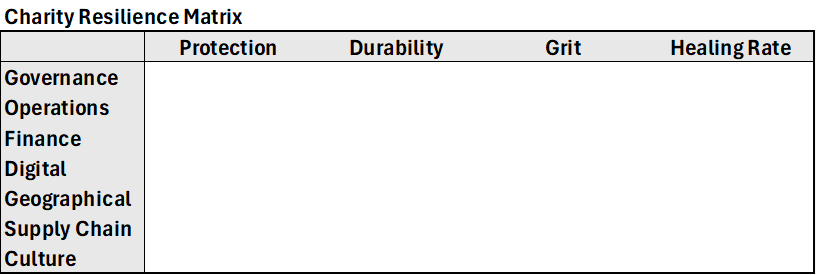
A generic, working definition of resilience is that it includes 4 key components: protection, durability (wear and tear), (human) grit and healing rate. Charity resilience can also be divided into various areas: governance, operations, finance, digital, geographical, supply chain and cultural.
Creating a matrix of rows and columns covering the 4 components and the 7 areas can be insightful to identify gaps and opportunities to strengthen resilience further.
Further, it’s possible to invest in resilience improvements that benefit more than one area. For example, ethics and technical training benefit both governance (risk oversight) and cultural resilience (reputation protection).
How is charity resilience linked to the charity risk register?
The charity risk register catalogues key risks, their owners and their mitigations. Charity resilience is an end-goal and a necessary condition to achieve the Charity Strategic Plan. Some charity risks relate to threats to resilience. By mitigating those risks, the probability of charity resilience is increased.
Resilience can be expressed as a current state and a target improved state. Risk scores in the risk register tend to be a snapshot in time. With risk appetite representing the target risk score in its totality.
Charity Resilience Assessment
Some independent assessments of charity resilience (impartial assessments can calm the critics) may come from the sector regulator, a bank lender (charity credit rating), insurance risk assessment, or the auditors. An example of the later would be the auditors’ feedback on internal controls and going concern.
It follows that achieving improved charity resilience can reduce risk for those suppliers, leading to lower fees, cheaper credit, or less extensive audits.
Feel free to reach out to Charity Strategy Together for help on developing charity resilience further.
A key concern of (charity) strategy is about building and maintaining advantage.
Strategic pillars, strategic intent and strategic themes in a Strategic Plan should describe how the charity will build and maintain advantage, while upholding its charity values. The Charity Mission is about the destination.
Building advantage includes building up charity resiliency (including to ‘black swam’ events) as its foundation.
The value of the advantage is described by the impact made (output and outcome stats).
Your advantage allows you to hold and strengthen your position. Consider both charitable activity scope and charitable service quality in your positioning.
Don’t be overly constrained by how your current funders or current beneficiaries see you. If your charitable activities sit across areas that multiple regulators regulate, that’s also fine.
Your board and SLT need to see their primary role as building advantage, for your strategy to succeed. Ask them at interview, what experience do you have in building advantage?
The opposite of building advantage is drift – your charity is forced by circumstance into a place it hasn’t planned for.
The term VUCA originated in the US military, specifically the US Army War College in the late 1980s/early 1990s. In the acronym (V) Volatility is about the speed and magnitude of change. (U) Uncertainty is about the lack of predictability or clarity about what will happen. (C) Complexity is about the many interconnected factors and variables. While (A) Ambiguity is about situations where cause, effect or meaning isn’t clear.
What can charities do if their environment is VUCA?
Volatility
This invites charities to anchor themselves in purpose, values and resilience, while developing an adaptive strategy to absorb shocks, respond quickly and protect against the impact of the changes.
Summary: Stabilise, create counters and adapt.
Action: Look at building unrestricted financial reserves, practice roleplay (train hard, fight easy) and regularly do scenario planning.
Uncertainty
This invites charities to maintain a portfolio of options and test assumptions through proportionate experimentation. Combine evidence, experience and insight to decide where to invest, adapt or stop. Have contingency plans. Develop reliable intelligence networks.
Summary: Seek expert advice, explore and learn.
Action: Brainstorm. Ensure rapid feedback loops. Verify sources independently. Look at developing an innovation pipeline.
Complexity
This invites charities to create sufficient decision space for systems thinking, collective sense-making and experimentation, while acting proportionately where delay would harm beneficiaries.
Summary: Understand and act.
Action: Explore systems mapping. Buy time for more analysis. Seek diverse points of view.
Ambiguity
This invites charities to test their interpretations through diverse perspectives, especially those of beneficiaries and communities, and to make values-led decisions while remaining open to revision.
Summary: Reframe and decide.
Action: Encourage structured challenge and beneficiary participation.
For charities, pivoting and drift can both involve significant changes in direction. The key difference is whether the charity chooses its new direction strategically (pivoting). Or is forced into a change of direction by circumstances (drift).
Strategic pivoting: a deliberate change in direction
Strategic pivoting is an agile but controlled change in direction. It occurs when a charity deliberately decides to change its activities or operating model, having first assessed the strategic implications and crucially, secured the funding needed to support the change.
Typically, the charity will have deliberately built a portfolio of options first. Although it may may not give it that name. The portfolio of options, by definition, gives the charity greater strategic choice, including on how, how fast and when to pivot. Some examples of options held might include: lines of credit, favours owed, large data sets, call options, surplus resource capacity, multi-skilled staff, multi-use buildings and strong unrestricted reserves.
A summary of the process:
Create a portfolio of options.
Update the strategy.
Secure the funding and resources.
Pivot the charitable activities.
Non strategic drift
Drift occurs when a charity’s direction changes, primarily because circumstances leave it with little choice. The change may be controlled to some extent. Or not. The charity is eventually and inevitably responding to external pressures, rather than deliberately following a strategy supported by a portfolio of options.
There are several ways this can happen.
1. Dependence on a dominant funder
A charity may move from dependence on one dominant funder to dependence on another funder with different priorities or objectives.
The charity has changed direction. But the new direction may be determined largely by the funder’s requirements, rather than the charity’s own strategy.
Analogy: the driver of the car has effectively been replaced by an outsider.
2. Lack of board alignment
A board may recognise that modernisation is necessary. But be unable to agree on what form it should take. Or be unable to agree on which ‘sacred cows’ to stop supporting.
The result can be prolonged indecision, repeated changes of direction, change missteps masquerading as progress, failure to gain traction, or incremental adjustments without a coherent destination.
Analogy: the car keeps turning in circles. While the occupants debate which road to take.
3. Low resilience to unexpected events
A charity with limited financial reserves, narrowly-concentrated income, or operational dependencies may have little capacity to absorb a sudden external shock e.g. a “black swan” event or other major disruption. In these circumstances, the charity may be forced to change its activities. simply to remain viable.
Analogy: a car travelling at speed suddenly encounters an unexpected road obstacle.
4. Traditional income streams become unviable
Some legacy income sources may gradually cease to make economic sense. Examples might include subletting surplus office space. Or operating a network of charity shops where gains from economies of scale aren’t achievable, or (low barriers to entry) competition has created an oversupply in the market. The issue is not necessarily that these activities were previously poor choices. Rather, that their economics have changed.
Analogy: the occupants of the car can no longer contribute enough funding to sustain the journey.
In these circumstances, the charity may have to reduce, replace or abandon traditional income sources. Without having had sufficient time to develop viable alternatives.
The importance of the charity’s ‘portfolio of options’
An investment portfolio contains a range of investments. A portfolio of properties contains a range of properties held. A portfolio of options is exactly that – a portfolio of options, held by the organisation at any point in time.
The distinction between pivoting and drift becomes clearer when viewed through the concept of a portfolio of options. A business-resilient charity deliberately develops options over time – for example:
diverse and complementary funding sources,
different income-generating activities,
strong partnerships and networks,
transferable organisational capabilities,
different programme or service models,
sufficient reserves and financial headroom,
the ability to scale activities up, down or in different directions.
When a charity has a strong portfolio of options, it can respond to changing circumstances, while retaining meaningful strategic choice. During a strategic pivot, that portfolio of options should remain sufficiently strong to support the transition.
During drift, the portfolio is typically already constrained – or becomes progressively smaller – as external pressures remove one option after another.
The mindset is therefore different:
Pivoting is: “Which direction will we choose?” Drift is: “When this drift ends, where will we find ourselves?”
The latter can become a case of stakeholders ‘bracing for impact’, rather than actively shaping the future.
How does pivoting relate to charity flexibility?
Charity flexibility can usefully be thought of as having four interconnected elements:
Adaptability – the organisation’s ability to evolve as its environment changes (evolution rate),
Agility – the organisation’s ability to change direction or pace, as circumstances change,
Resilience – the organisation’s capacity to protect itself, remain durable and heal, without losing its strategic viability, and
Portfolio of options – the range of viable choices available to it.
Pivoting is primarily an expression of agility. But agility does not operate in isolation. To elaborate, a charity can be agile but not resilient. For example, it may be able to change direction quickly. But have very limited financial capacity to withstand the consequences of doing so.
Equally, resilience without agility can result in a charity surviving a period of disruption without being able to adapt its underlying model.
The portfolio of options is therefore particularly important because it can connect agility and resilience.
Where a charity has maintained a strong portfolio of options, it is more likely that agility and resilience will reinforce one another. The charity can absorb disruption, assess alternatives and then deliberately pivot towards a viable future.
Where the portfolio of options has become degraded, the opposite can occur: resilience is weakened, strategic choice reduces, and what appears to be “agility” may actually be a rapid response to circumstances that the charity can no longer control.
Ultimately, the distinction is between changing direction because the charity has chosen to do so versus changing direction because the charity has run out of alternatives.
There are two sides to AI – supply-side and demand-side. Supply-side is how AI will significantly impact the Charity’s stakeholder groups.
Regarding supply-side, for a Charity that is a professional membership body or professions regulator, AI will have profound impacts on the members /registrants’ future careers and therefore on their future needs from the professional membership body/regulator.
Demand-side is how the charity is directly impacted by AI. Currently available tools like Anthropic’s Claude app can already speed up reporting and improve process efficiency.
On the demand-side, how AI systems will operate in a charity comes from their training. While their training comes from the data they are exposed to. Therefore, a part of a charity’s strategy for using AI, is to start capturing more kinds of data now. This includes:
data about funder segments and funder prospects,
data about staff and board skills,
data about beneficiary segments and beneficiary future needs, set against beneficiary demographics.
AI policies v AI strategy
AI policies are needed as guardrails on how the charity uses AI. The policies need to reinforce compliance with the charity’s values (be ethical, preserve confidentiality, preserve human dignity and be fair).
AI strategy is about using AI for competitive advantage. If the success of a given charity rests on how well it manages the gap between funder expectations and beneficiary expectations, then AI is an opportunity to improve that success rate.
Culture v Strategy
If culture is strategy in practice and if in future, a given charity creates a business model heavily reliant on AI (think data driven, mass customisation, AI profiling of both potential funders and potential beneficiaries), then will charity culture in such a charity largely be AI-driven? If so, then only by investing early in ethical and fair AI systems can the charity hope that its brand image and charity values will be adhered to.
In the corporate sector, business strategy is typically about seeking and maintaining competitive advantage to capture market share and satisfy a critical mass of customer demand. Customer demand typically remains limited, because customers link product and service value to price affordability.
For a customer shopping for tonight’s dinner in a supermarket, they’ll consider value (taste, freshness, nutrition, convenience) amongst rival products, relative to the price charged. For the customer, just because some products are ‘on special’ (discounted from the regular price), they won’t instantly buy a vast amount of that product, because; they lack funds, lack storage facilities and may value freshness as well. Current demand is therefore constrained.
In the charity sector, charity beneficiaries typically aren’t paying, or are only part-paying for the services provided by the charity. An example of the later is care home care provided to a beneficiary by a care home charity. Charity strategy is therefore about matching up charity funder ambition to the cost of providing charitable services, better than a rival charity can do so. It’s also no good being more cost efficient that a rival, unless the funder is aware of this. In the background, beneficiary demand is unconstrained.
Astute funders expect the charity to remain sustainable (invest and maintain necessary infrastructure and talent) and to clearly define the scope of operations, even if that means referring some charitable beneficiaries elsewhere. Charity strategy is therefore about seeking and maintaining competitive advantage through beneficiary need focus, deciding what level of quality to offer and deciding what not to do. From the charity’s perspective, where their funders aren’t being realistic (about the ‘price of funding’), educating them on what’s realistic for a given funder £ is important.
If the funders hear the same message from multiple independent charities about what ‘bang they’ll get for their buck’, that helps also. Given sufficient funds available, funders will then fund the charities where the value to the funder exceeds the price of funding. It follows that charity fundraisers can improve their effectiveness (funder acquisition and retention) if they search out and develop relationships with those funders where the gap between perceived charity value and the price of funding is the highest.
1. Risk management
Strategic risk management in a charity is about systematically reviewing the level of business resilience, whether to daily fluctuations (event attendees or bed occupancy levels say) or ‘black swan’ events. McKinsey studies have found organisations that invest in business resilience before disruptive events are typically the first to show a strong recovery afterwards.
2. Improve Impact
Charities face a strategic choice between (1) improving the charitable impact to a small number of beneficiaries or (2) improving the charitable impact by providing less comprehensive services, but to a wider range of beneficiaries. The problem with the first option is that the costs to provide bespoke services rise disproportionately against the extra impact achieved. It’s easier to scale up the number of beneficiaries with a fairly standard service provision and introduce additional services to a subset of those beneficiaries after the charity has captured economies of scale in delivery and back- office functions.
3. Broaden the funding base
By simply altering the Vision and Mission/Purpose of the charity in subtle ways, it can attract different funding partners, new volunteers and enable new income streams. However strategic thinking is desirable before the Vision/Mission alterations occur.
Diversifying the funder sources is also a risk mitigation measure.
4. Generate larger commercial trading net profits
Thinking strategically about potential commercial sectors and your relative advantage to succeed in those sectors, perhaps with commercial board expertise, a strong business case and some seed capital, can result in significant commercial profits to help subsidise charitable activities on an ongoing basis. One way to look at this is that even if your charity is less efficient than a rival charity in delivering charitable activities to beneficiaries, if there is a strong subsidy coming from commercial sources, the result is comparable.
5. Increase your charity influence in strategic alliances and with natural allies
Strategic alliances work best when both parties think strategically before they form the alliance. Natural allies are organisations who stand to gain from your charity success, but don’t currently support your charity with funding or benefits in kind. Your fundraising pitch to natural allies will be aided by evidence of strategic thinking by your charity.